


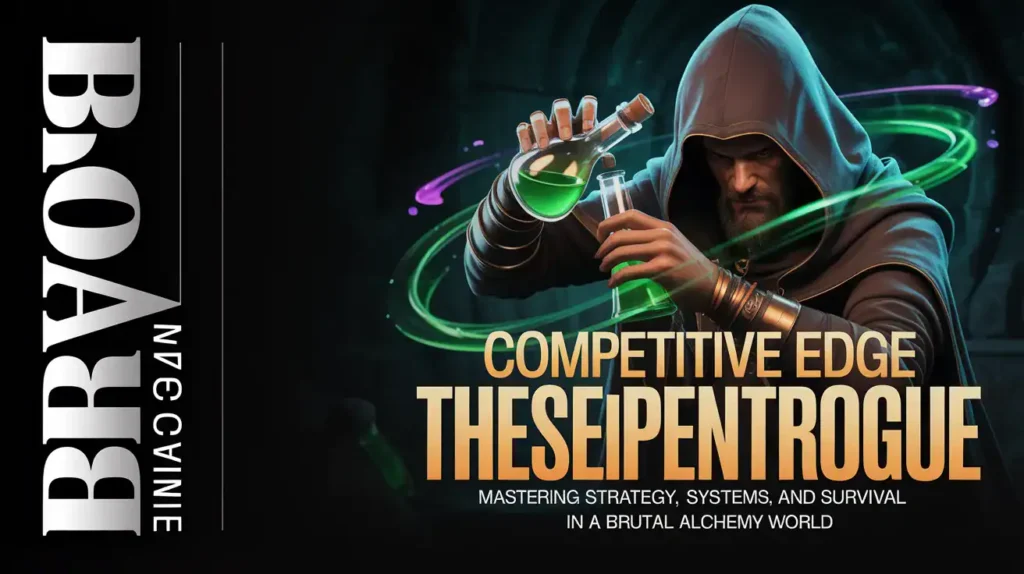
There are games that ask you to react fast, and then there are games that quietly punish you for not thinking three steps ahead. The Serpent Rogue belongs firmly in the second category. It doesn’t rush you, it doesn’t hold your hand, and it certainly doesn’t care if you survive your first few hours. That’s exactly where the idea of Competitive Edge TheSerpentRogue starts to make sense—not as a flashy mechanic, but as a mindset.
Players searching for this keyword usually aren’t just curious about the game itself. They’re trying to understand how to outsmart it. How to survive longer, craft better, manage corruption, and turn a seemingly unforgiving system into something predictable. And once you dig into it, you realize the game is less about brute force and more about controlled mastery.
This article breaks down that entire ecosystem—from mechanics to community perception—without overcomplicating what is, at its core, a beautifully harsh survival-alchemy experience.
What “Competitive Edge TheSerpentRogue” Actually Means
At first glance, The Serpent Rogue doesn’t look like a competitive game in the traditional sense. There are no ranked matches, no leaderboards screaming for attention, no PvP duels pushing you into meta builds.
So what does “competitive edge” even mean here?
It’s subtle. It’s internal.
In The Serpent Rogue, your competition is the system itself:
- The corruption spreading across regions
- Limited resources that never feel abundant
- Crafting systems that reward experimentation but punish ignorance
- Survival mechanics that evolve based on player behavior
The “edge” is knowledge. Players who understand alchemy, timing, exploration routes, and resource cycles naturally outperform those who don’t.
It’s less about beating other players and more about beating the world design itself.
The Serpent Rogue Overview: A Living System, Not Just a Game
To understand competitive advantage in this game, you need context on what it actually is.
Game Biography Table
| Category | Details |
|---|---|
| Title | The Serpent Rogue |
| Developer | Sengi Games |
| Publisher | Team17 |
| Release Date | April 26, 2022 |
| Genre | Action-adventure, survival, alchemy simulation |
| Engine | Unreal Engine |
| Platforms | PC, PlayStation, Xbox, Nintendo Switch |
| Core Theme | Alchemy, corruption control, survival exploration |
Unlike mainstream action RPGs, the game builds its identity around experimentation. There’s no fixed “right way” to play. Instead, players are dropped into a reactive world where even small decisions ripple outward.
That design philosophy is exactly why the idea of a “competitive edge” becomes relevant in the first place.
Development Journey: The “Early Life” of The Serpent Rogue
Every game has its own origin story, and The Serpent Rogue started as a passion project focused on blending alchemy systems with environmental storytelling.
Sengi Games leaned heavily into systems-driven gameplay rather than cinematic storytelling. Instead of scripting everything, they designed mechanics that create stories naturally. That decision shaped everything—from how enemies behave to how corruption spreads.
The early design challenge wasn’t content—it was balance.
How do you make a world feel unstable without making it unfair?
That tension still defines the final game.

Where Competitive Edge Comes From: Systems That Reward Intelligence
The real backbone of Competitive Edge TheSerpentRogue lies in its layered systems. Nothing works in isolation.
1. Alchemy Isn’t Just Crafting—It’s Power Control
Alchemy is not cosmetic. It’s survival.
You don’t just “make potions.” You:
- Experiment with unknown ingredients
- Risk poisoning yourself
- Discover hidden effects through trial and error
Players who memorize combinations or track ingredient behavior gain a massive advantage over casual explorers.
2. Corruption Mechanics Change Everything
Corruption isn’t just background lore—it actively reshapes the world.
- Areas become more dangerous over time
- Creatures mutate unpredictably
- Safe zones become temporary illusions
Understanding how corruption spreads allows experienced players to plan routes and resource runs efficiently.
That’s where the real edge begins forming: map awareness meets timing discipline.
3. Resource Scarcity Forces Strategic Thinking
There is no comfort loop here.
Everything:
- Has weight
- Has rarity
- Has consequences when wasted
A player who learns to manage inventory flow efficiently will consistently outperform someone who hoards or misuses materials.
4. Companion Systems and Risk Management
Managing creatures and companions introduces another layer of decision-making. You’re constantly balancing utility versus vulnerability.
A strong player doesn’t just collect allies—they evaluate them like tools.
Strategy, Mechanics, and Player Advantage
If you strip away aesthetics, The Serpent Rogue becomes a game of patterns.
And patterns can be mastered.
Early Game Advantage
Players who gain an edge early usually:
- Prioritize survival tools over experimentation
- Map resource zones quickly
- Avoid unnecessary corruption zones
This phase is less about creativity and more about discipline.
Mid Game Optimization
This is where skilled players separate from casual ones.
- Efficient alchemy loops
- Route optimization between safe zones
- Controlled experimentation with minimal risk
At this stage, knowledge compounds. One good discovery often unlocks several others.
Late Game Mastery
Late game becomes almost philosophical.
You’re no longer reacting—you’re predicting.
Experienced players:
- Manipulate corruption cycles
- Pre-craft for future zones
- Treat the world like a controlled ecosystem rather than chaos

Timeline of The Serpent Rogue’s Evolution
| Year | Event |
|---|---|
| Early Development | System-first design concept begins |
| 2021 | Public reveal and early gameplay showcases |
| 2022 | Official release across multiple platforms |
| Post-Launch | Community-driven discovery of mechanics and builds |
| Ongoing | Updates, discussions, and meta refinement |
Unlike live-service games, its evolution is slower but more interpretive. The community essentially “discovers” mechanics over time rather than waiting for patches to define them.
Lore, Atmosphere, and the Subtle Influence on Gameplay
The world of The Serpent Rogue is quiet—but not empty.
It tells its story through:
- Environmental decay
- Symbolic enemy design
- Alchemical experimentation themes
There’s a strange emotional undertone running through everything: curiosity mixed with unease.
This matters because atmosphere directly affects decision-making. Players often hesitate, overthink, or explore more cautiously because the world feels unpredictable.
That emotional pressure becomes part of the competitive edge itself.
Community Perception and Cultural Relevance
The community around The Serpent Rogue isn’t massive compared to blockbuster titles, but it is deeply analytical.
Players often:
- Share obscure potion discoveries
- Debate corruption mechanics
- Compare survival routes
- Break down hidden systems
What’s interesting is how the game attracts a very specific type of player: the experimental thinker.
These are not speedrunners or competitive PvP players. They’re system explorers.
And that shapes how the game is discussed online—less hype, more analysis.
Social Media Presence and Player Discussion
While the game doesn’t dominate mainstream gaming feeds, it maintains a steady presence through:
- Gameplay breakdown videos
- Indie game review channels
- Strategy threads on gaming forums
- Long-form YouTube analysis content
Most discussion revolves around one core idea: “What did I just discover?”
That curiosity-driven engagement is what keeps the game alive in niche communities.
Soundtrack Influence and Atmospheric Design
Although not a “music-driven” game in the traditional sense, the soundtrack plays an important psychological role.
The audio design is:
- Minimal
- Ambient
- Slightly unsettling
It reinforces the feeling of isolation and experimentation. Instead of pushing emotion, it supports tension.
This subtle approach enhances decision-making pressure, especially during exploration in corrupted zones.
Net Worth, Sales, and Commercial Reality
Unlike blockbuster franchises, exact revenue numbers for The Serpent Rogue are not publicly disclosed in detail.
However, what is clear is:
- It was published by a known indie-friendly publisher
- It reached multiple major platforms
- It built a steady niche audience rather than explosive mainstream success
The game’s value isn’t best measured in traditional “net worth” terms. Instead, its impact lies in long-term discoverability and continued community engagement.
Interesting Observations Players Often Miss
- Many systems reward patience more than aggression
- Early mistakes are often recoverable if understood correctly
- Exploration is intentionally inefficient to encourage learning
- The game subtly trains players to think like system designers
That last point is where everything connects back to competitive edge.
You’re not just playing—you’re learning how the game thinks.
Why “Competitive Edge TheSerpentRogue” Keeps Trending
Search interest around this keyword usually comes from three types of users:
- New players struggling with early survival
- Returning players trying to optimize runs
- Content creators breaking down mechanics
It trends because the game doesn’t explain itself well. Players have to decode it. And that decoding process naturally fuels search behavior.
Future Expectations and Longevity
While The Serpent Rogue is not positioned as a live-service title, its long-term relevance depends on:
- Continued indie community attention
- Strategy content creation
- Discovery of hidden mechanics by new players
Games like this don’t age through updates—they age through interpretation.
FAQ: Competitive Edge TheSerpentRogue
What does “Competitive Edge TheSerpentRogue” mean?
It refers to understanding the game’s systems deeply enough to outperform its survival and alchemy challenges efficiently.
Is The Serpent Rogue a competitive game?
Not in the traditional multiplayer sense. The competition is against mechanics, systems, and environmental pressure.
What gives players the biggest advantage?
Mastery of alchemy, resource management, and corruption control creates the strongest advantage.
Is the game difficult for beginners?
Yes, especially early on. The lack of clear tutorials makes experimentation essential.
Does the game have a storyline or focus more on systems?
It blends both, but systems and gameplay mechanics take priority over linear storytelling.
Why do players search for competitive edge strategies?
Because the game rarely explains its deeper mechanics, players rely on community knowledge and experimentation.
Is there a meta or best build?
Not strictly. Builds depend heavily on playstyle and discovered recipes rather than fixed “best” setups.
Conclusion
There’s something quietly unusual about games like The Serpent Rogue. They don’t rush to impress you, and they don’t care if you understand them immediately. Instead, they sit with you, challenge you, and slowly reveal that progress isn’t about speed—it’s about awareness.
That’s where the real Competitive Edge TheSerpentRogue lives. Not in shortcuts or exploits, but in patience, observation, and the willingness to fail until patterns start to make sense.
And once they do, the game changes shape entirely.
Not because it becomes easier—but because you finally start speaking its language.